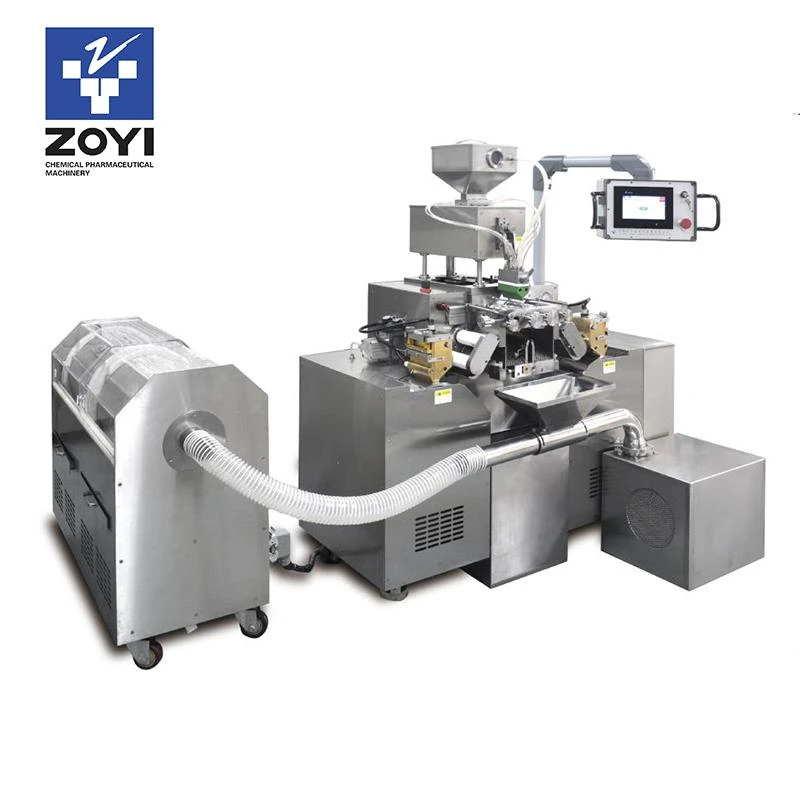
⚙️ Core Hardware Structural Upgrades
Eliminating latent faults-such as mechanical wear and operational drift-at the source, thereby significantly extending the service life of critical components.
1. The machine's core drive mechanism is upgraded to high-precision servo-motor control, greatly enhancing the operational stability of the left and right die-roll shafts, with a rotational speed deviation of ≤±0.1 r/min.
2. Die-roll spindles undergo high-precision grinding, with radial runout controlled within 0.02–0.05 mm and die-cavity coaxiality deviation ≤0.02 mm, preventing capsule deformation or leakage during long-term operation.
3. All components in contact with the product are constructed from 316L stainless steel; they are resistant to disinfectant corrosion, feature no "dead zones" for cleaning, and fully comply with pharmaceutical GMP standards.
4. The injection assembly is upgraded to a self-positioning, calibration-free design, ensuring a gapless fit between the nozzle and the die-roll surface throughout the process-structurally eliminating the risk of air entrapment that causes bubbles in capsules.
📊 End-to-End Closed-Loop Process Control
Establishing an interconnected parameter control model to eliminate parameter drift caused by manual adjustments, ensuring a closed loop for process stability.
1. Temperature control points across the entire system (spreader boxes, injection assemblies, gelatin tanks, and liquid-fill piping) utilize PID closed-loop control, keeping temperature fluctuations within ±0.5°C and ensuring gelatin viscosity remains stable.
2. Die-roll closing pressure is monitored via real-time feedback from pressure sensors, maintaining a stable range of 0.3 MPa ±0.05 MPa. This ensures a seam thickness of ≤0.05 mm and a seal burst strength of ≥15 N.
3. Precise control of gelatin formulations: The ratios of gelatin, plasticizers, and purified water are strictly locked, and pigments undergo a desalting pretreatment, which can extend the product's shelf life to over 24 months.
4. A standardized process recipe library is implemented, allowing parameters-such as nozzle positioning, lubrication volume, and die-closing pressure-to be saved and recalled with a single click, effectively eliminating human operational error.
🛠️ Full-Cycle Preventive Maintenance System
Implement standardized maintenance tasks across various time intervals to nip potential malfunctions in the bud, preventing minor issues from accumulating into unplanned downtime.
1. Perform a 2-minute "dry run" (idling) before each shift. Inspect the machine for fluid leaks and ensure smooth operation of all drive components; proceed with production only after confirming there are no abnormal noises.
2. At the end of each shift, thoroughly purge all residual materials from the gelatin and liquid supply lines. Disassemble and clean the dispensing unit, metering pumps, and piping; use a soft-bristled brush and warm water to clean the cavities of the rotary dies.
3. Conduct in-depth weekly maintenance: remove dust and debris from inside the equipment, apply food-grade lubricant to chains and gears, and tighten any loose fasteners.
4. Perform comprehensive monthly calibration: verify the dosing accuracy of the liquid metering pumps, inspect pneumatic components and tubing for signs of aging or cracking, and check the continuity of the machine's grounding system to ensure electrical safety.
🔧 Optimization of Auxiliary Equipment
Implement targeted modifications to post-processing units-such as drying and shaping systems-to enhance the overall stability of the entire production line.
1. Modify the independent tumble dryer (rotating cage) by installing irregularly distributed PTFE (Teflon) strips on the inner walls. This alters the movement path of the capsules, effectively eliminating issues with sticking or clumping.
2. Swap the positions of the drive and driven gears on the tumble dryer to reduce the residence time of soft capsules from 4 minutes to 1 minute, significantly lowering the risk of capsule deformation.
3. Following these modifications, the cleaning time for the tumble dryer is reduced from 30 minutes to 10 minutes, which minimizes the risk of cross-contamination and greatly improves efficiency during product changeovers.
4. Implement closed-loop, integrated control for airflow velocity, rotation speed, and inlet air temperature within the drying unit, ensuring the moisture content of the soft capsule shell remains consistently within the GMP-compliant range of 12%–15%.
5. Would you like me to prepare an actionable implementation checklist for enhancing the stability of your soft capsule machine? I can tailor it to your specific production environment for rapid deployment.