Hey there! As a supplier of colloid grinders, I've been getting a lot of questions lately about the effect of the magnetic field on the grinding performance of a colloid grinder. So, I thought I'd take a moment to share some insights on this topic.
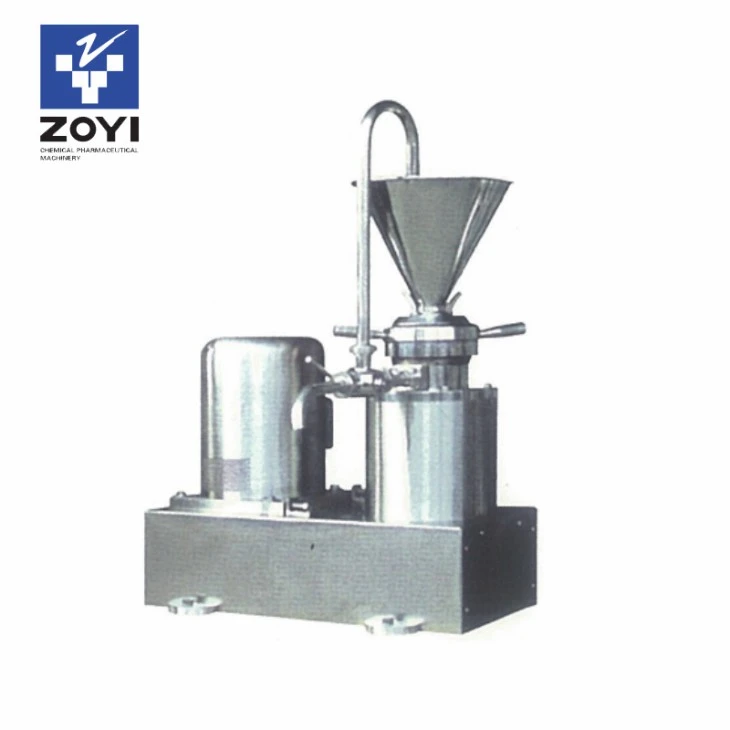
First off, let's talk about what a colloid grinder is. A colloid grinder is a machine used to reduce the particle size of a substance to a very fine level. It's commonly used in industries such as food, pharmaceutical, and cosmetics to create smooth, homogeneous mixtures. The basic principle behind a colloid grinder is to use a high-speed rotating disc or rotor to shear and grind the material between the rotor and a stationary stator.
Now, let's get into the magnetic field. A magnetic field is a region in space where a magnetic force can be detected. In the context of a colloid grinder, the magnetic field can have several effects on the grinding performance.
One of the main effects of the magnetic field is on the dispersion of the particles. When a magnetic field is applied to the colloid grinder, it can cause the particles to align in a certain direction. This alignment can help to break up agglomerates and improve the dispersion of the particles in the mixture. As a result, the grinding process becomes more efficient, and the final product has a more uniform particle size distribution.
Another effect of the magnetic field is on the viscosity of the mixture. The magnetic field can interact with the particles in the mixture and cause them to move in a way that affects the viscosity. In some cases, the magnetic field can reduce the viscosity of the mixture, making it easier to process. This can be particularly beneficial in applications where a low-viscosity product is desired.
In addition to these effects, the magnetic field can also have an impact on the wear and tear of the colloid grinder. The magnetic field can help to reduce the friction between the rotor and the stator, which can extend the lifespan of the machine. This is because the reduced friction means less wear on the components, resulting in fewer breakdowns and maintenance requirements.
However, it's important to note that the effect of the magnetic field on the grinding performance can vary depending on several factors. These factors include the strength of the magnetic field, the type of material being ground, and the design of the colloid grinder.
For example, if the magnetic field is too strong, it can cause the particles to clump together, which can actually reduce the grinding efficiency. On the other hand, if the magnetic field is too weak, it may not have a significant effect on the grinding performance.
The type of material being ground also plays a role. Some materials are more susceptible to the effects of the magnetic field than others. For example, materials that contain magnetic particles will be more affected by the magnetic field than materials that do not.
Finally, the design of the colloid grinder can also influence the effect of the magnetic field. Some colloid grinders are designed to take advantage of the magnetic field, while others may not be. For example, some colloid grinders have a magnetic separator built into the machine, which can help to remove any magnetic particles from the mixture.
So, how can you determine the optimal magnetic field strength for your colloid grinder? Well, the best way is to conduct some tests. You can start by applying a weak magnetic field and gradually increasing the strength until you find the optimal level for your specific application.
In conclusion, the magnetic field can have a significant effect on the grinding performance of a colloid grinder. By understanding how the magnetic field works and how it can be optimized, you can improve the efficiency and quality of your grinding process.
If you're in the market for a colloid grinder, we offer a wide range of options, including the Colloid Mill Grinder, Gelatin Colloid Mill, and Stainless Steel Colloid Mill. Our colloid grinders are designed to provide high-performance and reliable operation, and we can help you choose the right machine for your specific needs.
If you have any questions or would like to discuss your requirements further, please don't hesitate to get in touch. We're here to help you find the best solution for your grinding needs.